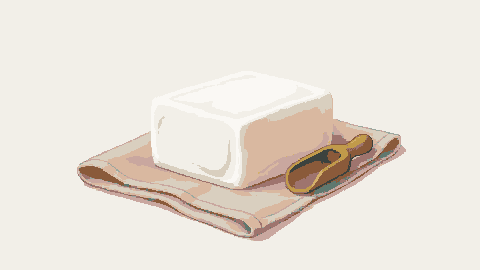
What tallow is
Tallow is beef fat that has been rendered: gently heated, strained and purified until it becomes a smooth, stable fat. In cosmetics it appears on ingredient lists under the INCI name Tallow, and it has been used in soaps, balms and ointment bases for centuries.SAGE
The recent interest in tallow comes from a simple observation: the fats it is made of are the same families of fats found in human skin lipids. That does not make it a treatment for anything, but it is why tallow-based moisturisers feel unusually compatible on dry, reactive skin. Our beef tallow ingredient page covers the INCI and safety detail.
Why it resembles skin lipids
Skin's outer layer is held together partly by fatty acids and lipids. Tallow's composition lands in a similar neighbourhood: the Cosmetic Ingredient Review dossier lists typical ranges of roughly 37-43% oleic, 24-32% palmitic and 20-25% stearic acid, with smaller amounts of linoleic and palmitoleic acids.CIR
Stearic and palmitic acids are established barrier-supporting components in moisturisers and cleansers, which is part of the mechanistic case for tallow as an emollient.PubMed One honest caveat in the other direction: at higher exposures oleic acid has been shown to increase water loss rather than reduce it in human-skin studies, which is why tallow works best in a balanced formula rather than slathered on neat.ACS
What the evidence supports
Being straight about this matters more than the marketing version. A 2024 scoping review of tallow's biocompatibility with skin concluded that its composition makes a plausible emollient and that historical use is long, while noting that modern clinical trials are limited.PubMed
What that means in practice:
- Well supported: tallow is a safe cosmetic ingredient as used (CIR safety assessment), its fatty acids match known emollient chemistry, and occlusive-emollient products as a class reduce water loss.
- Early-stage: controlled trials of tallow itself for specific skin outcomes.
- Not supported by evidence: any claim that tallow treats or cures a skin condition. It does not, and we do not claim otherwise.
Sourcing and rendering
Tallow quality depends on the raw suet and how it is rendered. Ours is rendered for cosmetic use and purified to remove odour and impurities, so what ends up in the jar is a clean, neutral-smelling fat. The Cosmetic Ingredient Review's safety assessment of tallow and tallow glycerides concluded they are safe as used in cosmetics.SAGE
If you are comparing tallow products, the questions worth asking any maker are: where does the suet come from, how is it rendered and filtered, and does the finished product smell of beef? A properly rendered tallow should be near-neutral.
Who it suits, and who should skip it
Tallow balms tend to suit people with very dry, tight or weather-beaten skin, people who find light lotions insufficient, and anyone who wants a short ingredient list. Because the formulas are simple and typically fragrance-free or lightly scented, they are a frequent pick for sensitive skin and babies' dry patches.
Who might prefer something else: very oily or congestion-prone skin may find a rich balm too heavy for the face, though comedogenicity data is more nuanced than the internet suggests (a dedicated guide is coming in this series). And anyone avoiding animal-derived ingredients for personal reasons will want the plant-based alternatives like shea butter or jojoba instead.
How to use it
Tallow cream works like any occlusive emollient: apply to slightly damp skin to trap water in rather than seal dryness in. A pea-sized amount warms between fingers and spreads further than expected; more is not better.
- Face: smallest amount, evening first while you see how your skin responds.
- Body: after bathing, on still-damp skin.
- Hands and feet: thicker layer before bed for rough patches.
- New to it? patch-test on a small area first, as with any new leave-on product.
Starter picks: our tallow moisturisers are built on it as the hero ingredient; the fragrance-free Original is the gentlest entry point.
How to read a tallow product label
Because tallow products range from kitchen-rendered fat to finished cosmetic formulas, a few things separate a considered product from a jar of cooking fat.
- Rendered and purified: cosmetic tallow should be rendered, filtered and refined until it is a clean, stable fat. That process is what removes the meaty smell and the proteins that would otherwise spoil.
- Whipped or blended: pure tallow is firm. Whipping or blending with partner emollients is what makes a balm spreadable rather than a waxy puck.
- A short INCI list: anhydrous tallow balms need no preservative system, so a genuinely minimal product lists a handful of ingredients, not twenty.
- Honest claims: a brand that tells you tallow treats skin conditions is telling you more about its marketing than its fat.
Tallow in the formula, not just the jar
How a balm is built matters as much as the headline ingredient. Whipping changes texture without changing chemistry, and partner ingredients shift the whole feel of a product: shea butter adds cushion and a richer film, plant oils like jojoba or babassu lighten the finish, and a wax like candelilla sets the structure without heaviness.
This is why two products that both say tallow on the front can feel completely different on skin. The ingredient page for beef tallow covers the INCI and safety detail; the comparison pages in this series, tallow vs shea butter and tallow vs ceramides, cover how it stacks up against the alternatives.
FAQs
Question
Is tallow just cooking fat?
Answer
Same source material, different product. Cosmetic tallow is rendered and purified to a standard suitable for leave-on skincare: filtered, deodorised and assessed under cosmetic safety review.SAGE Dripping from the roasting tin is not the same thing.
Question
Does tallow smell of beef?
Answer
Properly rendered and purified tallow is near-neutral. If a tallow product smells strongly of cooking, the rendering was incomplete.
Question
Is tallow suitable for sensitive skin?
Answer
Tallow itself is a simple, single-ingredient fat with a long cosmetic history and a clean safety assessment, which is why it shows up in products aimed at sensitive skin. Sensitive skin is individual though: patch-test first, and for active eczema or broken skin, follow your pharmacist or GP's advice.
Question
Is tallow comedogenic?
Answer
Widely cited comedogenic ratings put tallow low, and many people use it without congestion, but pore response is individual. A dedicated guide covering the evidence and how to patch-test is coming in this series.
Question
Is tallow the same as suet or lard?
Answer
Related but different. Suet is the hard fat from around the kidneys; tallow is suet (or other beef fat) after rendering and purification. Lard is rendered pork fat, a different animal and a different fatty-acid profile. Cosmetic tallow is the rendered, purified beef fat.
Question
Does tallow smell like beef?
Answer
Properly rendered and purified tallow smells neutral to faintly waxy. A strong meaty or off smell is a sign of incomplete rendering, which is a quality red flag rather than a tallow property.
Question
Is tallow just a trend?
Answer
The social-media wave is new; the ingredient is not. Tallow appears in cosmetic safety assessments and ointment bases going back generations. What is new is the modern framing, and the honest evidence summary is in the sections above.
Question
Where should I start if I am new to tallow skincare?
Answer
Start with the evidence summary in the sections above and the beef tallow ingredient page for INCI and safety detail. Then patch-test like any new product: a small amount on the inner forearm for a few days before committing to wider use.
Question
Is tallow skincare suitable for vegans?
Answer
No, it is an animal fat by definition. If that rules it out for you, the closest plant-based occlusives are shea butter and candelilla-wax balms, and our tallow vs shea comparison covers where they differ.
References
Tallow biocompatibility scoping review (2024)
Russell MF et al. Tallow, Rendered Animal Fat, and Its Biocompatibility With Skin: A Scoping Review. Overview of evidence; limited modern trials.PubMedCIR safety assessment of tallow
Final Report on the Safety Assessment of Tallow, Tallow Glyceride(s) and related ingredients: safe as used in cosmetics.SAGE JournalsCIR composition ranges
CIR dossier: typical fatty-acid ranges for tallow (oleic 37-43%, palmitic 24-32%, stearic 20-25%).CIRStearic and palmitic acids in barrier care
Reviews on stearic and palmitic acids as barrier-supporting components in moisturisers and cleansers.PubMedOleic acid and water loss (caution evidence)
Human-skin studies showing oleic acid can increase transepidermal water loss at higher exposures.ACSHistorical context: animal-fat ointment bases
Royal Pharmaceutical Society museum note on traditional animal-fat ointment bases.