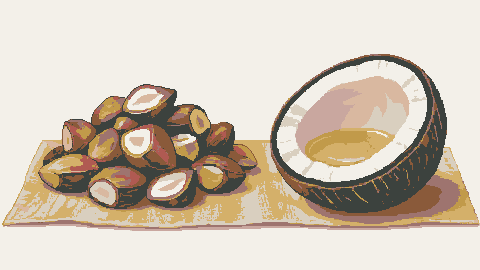
Where each oil comes from
Coconut oil is pressed from the flesh of the coconut, Cocos nucifera, and needs little introduction. It is one of the most used emollients in both food and cosmetics.
Babassu oil comes from the kernels of the babassu palm, Attalea speciosa, a wild-growing palm native to Brazil. The kernels are hand-cracked by women working in harvesting cooperatives, which makes babassu one of the more socially grounded supply chains in natural skincare. Research into babassu lipids is active but concentrated on extraction and composition rather than skin outcomes.PubMed
Both arrive as pale, softly solid fats that liquefy at skin temperature. If you smeared them side by side blind, most people could not tell which was which in the first few seconds.
Fatty acid profiles, in plain terms
Both oils are dominated by lauric acid, the medium-chain fatty acid that gives them their firm texture and quick-melt behaviour. Coconut oil runs around 45 to 50 percent lauric acid with meaningful amounts of myristic and caprylic acids. Babassu oil is similar or slightly higher in lauric content, with the remainder spread across myristic, palmitic and oleic acids.
Practically, that shared lauric backbone is why the two oils can substitute for each other in formulas: they contribute the same glide-and-set behaviour that makes a balm feel rich without staying greasy. The differences that matter to a formulator are the tail of the profile, the unsaponifiable fraction, and how the oil behaves in a blend.
How they feel on skin
Most people describe babassu as the lighter of the two. It tends to absorb a little faster and leave a slightly less occlusive film, which is why it shows up in summer balms and products aimed at skin that dislikes heavy residue.
Coconut oil sits a touch heavier and a touch longer. For very dry skin that extra film is a feature. For skin that runs oily, congested or reactive, it can feel like too much. Neither judgement is universal, which is why both oils have loyal followings.
The comedogenic question, honestly
Coconut oil carries a reputation for clogging pores, built mostly on old comedogenicity ratings measured on rabbit ears at high concentrations. Those scores are a rough screen, not a verdict: the same studies show individual variation is enormous, and the rabbit-ear model over-predicts congestion compared to human skin.
Babassu is often marketed as the non-comedogenic alternative. The fair version of that claim is softer: its lighter feel and faster absorption plausibly reduce the window for congestion, but there is no robust human trial proving it clogs less. We compare this in more depth on our comedogenicity guide, which covers how little those published ratings actually tell you.
If your skin congests easily, the sensible move is to trial a small amount for two weeks rather than trust a number on a list.
Allergy and sensitivity angle
For anyone avoiding coconut, whether for a confirmed allergy, a suspected sensitivity, or simple preference, babassu is the easiest like-for-like swap in the ingredient world. It fills the same role in a formula without carrying coconut-derived compounds.
True coconut allergy is uncommon, as our coconut allergy guide explains, but the need for a credible alternative is real. Babassu is why a coconut-free balm does not have to feel like a compromise.
Why we chose babassu for Extra Sensitive
When we built Extra Sensitive, the brief was a balm for people who cannot use coconut or beeswax and do not want fragrance. Deleting coconut oil would have left a hole: it is the ingredient that gives a simple balm its instant-melt glide.
Babassu filled it almost invisibly. Same lauric backbone, same behaviour in the blend, lighter finish on skin, and none of the coconut-derived compounds that concern our more reactive customers. Alongside squalane for slip and candelilla wax for structure, it is the reason Extra Sensitive feels like a real balm rather than a restricted one.
Which is right for you
Choose coconut-oil formulas, like our Original, if your skin tolerates coconut and you like a richer, longer-lasting film. Choose a babassu-based formula if you avoid coconut, if your skin congests on heavier oils, or if you simply prefer a faster-absorbing feel. If you are not sure, the skin quiz matches you to a formula in about a minute.
Sourcing and sustainability
Coconut oil is a plantation crop at industrial scale: efficient, well-supplied, and largely interchangeable in a commodity market. Babassu is different in kind. The palms grow wild across the transition zone between the Amazon and the Cerrado, and kernels are gathered rather than farmed. Harvesting cooperatives, mostly led by women, hand-crack the exceptionally hard shells, one reason babassu costs more and supplies are less elastic.
For a small maker that difference matters less as a marketing story and more as a practical question: can we get a consistent supply of a food-grade oil, from suppliers we can verify, at a price that lets the product exist? So far the answer has been yes, and the cooperative supply chain is a genuine bonus on top of the formulation argument.
How the comparison plays out in a finished balm
Inside a formula, the two oils rarely work alone. Coconut oil in Original pairs with tallow, shea and beeswax for a richer, slower-melting balm. Babassu in Extra Sensitive pairs with squalane and candelilla wax for a lighter, faster-settling texture.
So the real-world choice is less babassu versus coconut and more which finished formula suits your skin. The oil comparison tells you about feel and exclusions; the balm comparison is what you actually put on.
FAQs
Question
Is babassu oil just a trendy name for coconut oil?
Answer
No. They are different plants with different chemistry and supply chains. Babassu comes from a wild Brazilian palm kernel and is often hand-harvested by cooperatives; coconut comes from cultivated coconut flesh. They share a lauric acid backbone, which is why they behave similarly in a formula, but they are not the same ingredient.
Question
Is babassu oil safe for sensitive skin?
Answer
It has a good track record as a gentle emollient and is the base of our most reactive-skin formula, but no ingredient is universally safe for everyone. Patch test as you would with anything new.
Question
Does babassu smell like coconut?
Answer
Barely. Refined babassu is close to odourless, with none of the coconut scent some people find cloying. If you dislike the smell of coconut oil, babassu is an easy adjustment.
Question
Which is better for eczema-prone skin?
Answer
Neither has the clinical evidence to claim superiority. Virgin coconut oil has trial data as an emollient on atopic skin; babassu has a thinner evidence base but a good gentleness record. Individual tolerance matters more than the comparison, and our eczema-prone skin guide covers the wider picture.
Question
Is babassu oil more expensive than coconut oil?
Answer
Yes, meaningfully so at supply level. Wild harvesting and hand-cracking make it a smaller, less industrial supply chain. For a balm-sized ingredient percentage the difference is absorbed into a modest retail price, but it is one reason babassu shows up in premium formulas rather than mass-market ones.
Question
Which is better for hair?
Answer
Both are used in hair care and both behave similarly there thanks to the shared lauric profile, which lets them penetrate the hair shaft more than heavier oils. Babassu is often described as the lighter-feeling option for fine hair, though that is user consensus rather than trial data.
Question
Where do the fatty acid numbers come from?
Answer
Published composition analyses of both oils, which consistently show lauric acid dominant in each. The exact percentages vary by crop and batch, which is why we quote ranges rather than a single figure.
Question
Can I use babassu oil on its own, neat?
Answer
Yes, it is sold as a standalone oil in some shops and works as a light body or hair oil used neat. In our range it arrives inside the Extra Sensitive formula, where it does its work alongside squalane and tallow rather than alone.
References
Babassu lipid extraction and composition research
Research on babassu kernel lipids: extraction methods and fatty acid composition (2026).PubMedBabassu oil nutritional profile study
Babassu oil composition: lauric-dominant fatty acid profile and low essential fatty acid content.PubMedVirgin coconut oil in childhood atopic dermatitis (RCT)
Evangelista MTP et al., 2014. Randomised double-blind trial of virgin coconut oil vs mineral oil.WileyCoconut oil and S. aureus on atopic skin
Verallo-Rowell VM et al., 2008. Virgin coconut oil reduced S. aureus colonisation vs olive oil on atopic skin.PubMedCoconut oil emollient and sensitisation in preterm infants
Prospective cohort: routine coconut oil skin care in ninety preterm infants; no coconut sensitisation at fifteen months (2025).PubMed