What each wax is
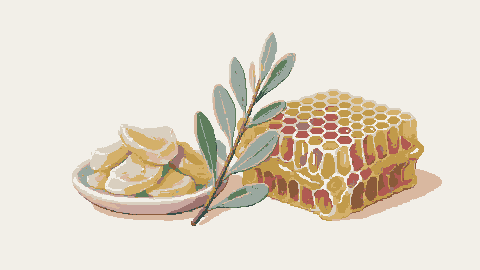
Beeswax is secreted by honeybees to build honeycomb. It has been used in salves and balms for centuries and remains the default structuring wax in natural skincare. The Cosmetic Ingredient Review panel assessed beeswax and related waxes as safe for cosmetic use.CIR
Candelilla wax comes from the leaves of a small desert shrub, Euphorbia antisyphilitica, native to northern Mexico and the southwestern United States. The plant coats itself in wax to slow water loss, and harvesters boil the stalks to collect it. It is harder and more brittle than beeswax, which is why formulas need less of it.
Both belong to the broader family of structuring waxes reviewed in cosmetic formulation literature.dermaviduals
What a wax does in a balm
Without a wax, a tallow-and-oil blend is a soft paste that melts to liquid in a warm room. The wax builds a microscopic crystal scaffold through the oil phase: firm enough to hold shape in the tin, brittle enough to break down on contact with warm skin.
The wax also controls glide and payoff: how much product transfers per pass, how it spreads, and how quickly it sets back down. Choosing a wax is choosing the texture of the whole product, which is why the swap is never a straight one-for-one.
How they differ in texture
Beeswax produces a dense, slightly tacky balm with a slow, cushioned melt. It clings, which is pleasant on very dry skin and can feel heavy on skin that prefers a lighter film.
Candelilla produces a firmer, glossier balm that melts faster and sets with less tack. Because it is harder, formulas use roughly half as much to reach the same firmness, and the finished balm tends to feel cleaner and less waxy on the skin. The trade-off is a slightly more brittle crystal structure, which a skilled formulator balances with the oil blend.
The sensitivity angle
Most people tolerate both waxes well. The meaningful sensitivity question sits with bee products rather than the wax itself: propolis and related hive-derived compounds are documented contact allergens, and trace propolis can carry through into unrefined beeswax. For someone with a confirmed bee-product sensitivity, avoiding hive-derived ingredients altogether is the cautious path.
Candelilla sidesteps that entirely. It is a single-species plant wax with a long use record in cosmetics and confectionery. If you suspect a reaction to a beeswax balm, a candelilla-based formula is the cleanest way to test whether the wax was involved.
The vegan question, honestly
Candelilla is plant-derived; beeswax is not. That part is simple. What is less honest is the implication that choosing candelilla makes a balm vegan, because most tallow balms, including ours, still contain animal fat. We formulate with candelilla for sensitivity and texture reasons, not to claim a vegan product we do not make.
If you are fully plant-based, neither our Original nor our Extra Sensitive will suit you, and we would rather say that plainly than sell you a misleading impression.
Why we chose candelilla for Extra Sensitive
Extra Sensitive is built for the most restricted customers: no coconut, no added fragrance, and no beeswax. Dropping beeswax removed the ingredient most likely to carry hive-derived trace allergens, and candelilla gave us the structure we needed without it.
The result is a balm that sets cleanly, melts fast on contact, and keeps the babassu and squalane oils in suspension. If you are the customer who reads every ingredient twice, that is the formula built for you.
Which is right for you
If your skin is uncomplicated, beeswax formulas like Original are a time-tested choice and most people do beautifully on them. If you have reacted to beeswax products, have a bee-product sensitivity, or prefer a lighter, less tacky film, a candelilla formula is worth the switch.
Sourcing and supply
Beeswax is a byproduct of honey production, collected when beekeepers render comb and cappings. Its supply follows the health of beekeeping itself, and quality varies with how thoroughly it is filtered and whether it is used refined or raw.
Candelilla comes from wild-harvested shrubs in the Chihuahuan desert, where the stalks are boiled with a dilute acid to release the wax. It is a traditional cottage industry in northern Mexico with a long export history into cosmetics and confectionery. Neither supply chain is perfect, but both are traceable in a way that matters when you are the one writing the ingredient list.
Other waxes in the family, briefly
Formulators keep a small cast of structuring waxes on hand. Carnauba is the hardest plant wax and adds gloss but very little flexibility. Rice bran and sunflower waxes are milder and used for softer textures. Candelilla sits in a useful middle: firm enough to set a balm, workable enough to avoid brittleness, and with a shorter ingredient story than blended alternatives.
Spotting the wax on a label
Beeswax appears as cera alba (white, refined) or cera flava (yellow, less processed). Candelilla shows up as Euphorbia cerifera (candelilla) wax, the older botanical name that INCI still uses.
Waxes typically sit in the middle of an ingredient list: high enough to set the product, low enough that they are never the star. If you are comparing two balms and want to know which texture to expect, find the wax first, then look at how far up the list it sits. A balm led by candelilla will generally read firmer and set faster than an equivalent beeswax formula.
What the wax does not do
It is worth being clear that a wax is not a moisturising active. Neither beeswax nor candelilla hydrates skin or treats anything. Their contribution is mechanical: structure in the tin, glide on application, a light occlusive film afterwards. The conditioning work in a balm belongs to the oils and butters, and any wax marketed as a treatment ingredient is borrowing credibility it has not earned.
FAQs
Question
Does candelilla perform as well as beeswax?
Answer
Structurally, yes. It is actually harder than beeswax, so less is needed for the same firmness. The feel differs: candelilla balms are glossier and less tacky. Which you prefer is personal.
Question
Can beeswax cause skin reactions?
Answer
Rarely on its own, but unrefined beeswax can carry traces of propolis and other hive compounds that are documented contact allergens. If you suspect a reaction, patch testing can identify the responsible ingredient.
Question
Is candelilla wax sustainable?
Answer
It is a wild-harvested desert shrub wax with a long harvesting tradition in northern Mexico. As with any wild crop, sustainability depends on the supply chain; it is a fair question to put to any brand using it.
Question
Is candelilla wax vegan?
Answer
The wax itself is plant-derived. Whether a product containing it is vegan depends on the rest of the formula. Our balms contain tallow, so they are not vegan regardless of the wax used.
Question
Does beeswax have skin benefits beyond structure?
Answer
It contributes a light occlusive film and a familiar cushioned feel, and traditional use credits it with soothing properties. In a modern formula its main job is structural: it makes the balm a balm. The conditioning work in ours is done by the oils and butters.
Question
Why do some people prefer plant waxes?
Answer
Three usual reasons: sensitivity to hive-derived compounds, vegan or plant-based preference for the formula as a whole, and texture preference for the firmer, less tacky set that candelilla gives. Ours is the first of those.
Question
Does the wax change how the balm smells?
Answer
Slightly. Unrefined beeswax carries a soft honey note; candelilla is close to odourless. In a fragrance-free formula like Extra Sensitive the absence of a honey note is part of keeping the product neutral.
Question
Can I be allergic to candelilla?
Answer
Published reports of candelilla allergy are rare and it has a long safety record in cosmetics and confectionery. Rare is not never, so patch testing remains the sensible habit with any new product.
References
CIR safety assessment of cosmetic waxes
Cosmetic Ingredient Review. Safety assessment of plant- and animal-derived waxes including beeswax and candelilla as used in cosmetics.CIRWaxes in cosmetic formulation
Dermaviduals technical publication on the wax family in cosmetics: structure, function and selection.dermavidualsContact dermatitis to cosmetic ingredients
Contact Dermatitis journal: allergic contact dermatitis literature relevant to cosmetic waxes and bee-derived ingredients.WileyBeeswax overview
Composition and uses of beeswax, including its role in cosmetic applications.Wikipedia